
Investment Rounds and Shareholder Agreements: Keys to Success

Funding rounds and shareholder agreements are fundamental elements in the growth of startups and emerging companies. Properly structuring these agreements not only ensures the necessary capital acquisition but also establishes the foundations for a balanced relationship between founders and investors.
Types of Investment Rounds: From Seed Capital to Series
The funding path of a startup typically follows a sequence that adapts to its level of maturity:
- Pre-seed and FFF (Family, Friends & Fools): First informal fundraising, usually among people close to the founders and with very early valuations.
- Seed Round: First formal round, aimed at validating the product or service, with typical values between €100,000 and €1 million.
- Series A: Financing for companies that have already validated their business model and are looking to scale, generally with valuations between €2 and €10 million.
- Series B, C and beyond: Targeted at companies in expansion phase, internationalization or preparation for an eventual exit.
Shareholder Agreements: The Private Constitution of the Company
The shareholder agreement is a private contract that regulates the relationships between partners and establishes fundamental rules for the operation and governance of the company. Essential aspects it should include:
- Corporate governance clauses: Definition of reinforced majorities for key decisions, board composition, veto rights, etc.
- Permanence and dedication clauses: Obligations of founders regarding their dedication to the project and minimum permanence.
- Share transfer clauses: Include rights of first refusal, drag-along clauses, tag-along, anti-dilution, etc.
- Exit and liquidity clauses: Mechanisms for orderly exit in case of deadlock or conflict between partners.
- Non-competition and confidentiality agreements: Temporal and material limitations to the activity of partners after their departure.
Startup Valuation: Art and Science
Startup valuation is one of the most complex and determining aspects in an investment round. The most commonly used methods include:
- Valuation by comparables: Based on similar operations in the sector.
- Discounted cash flow valuation: Although complex in early startups, it can be relevant in more advanced stages.
- Berkus Method: Assigns monetary values to key elements such as team, technology, commercial traction, etc.
- Scorecard Method: Compares the startup with similar ones, adjusting the value according to various risk factors.
Dilution: The Price of Growth
Dilution is the percentage reduction of existing shareholders' participation after a capital increase. It is inevitable in successive rounds but must be strategically managed:
- Stock options pool: Reserve a percentage of capital for incentives to key employees.
- Anti-dilution protections: Mechanisms that protect investors against subsequent rounds at lower valuations.
- Ratchets: Adjustments to the conversion price of convertible instruments based on company performance.
- Pay-to-play: Clauses that encourage the participation of existing investors in subsequent rounds.
Practical Advice for Entrepreneurs
Based on our experience advising startups in investment rounds, we recommend:
- Thorough preparation: Impeccable legal and financial documentation, including a clear cap table and preventive due diligence.
- Balance in negotiation: Resist the temptation to accept excessively high valuations that make future rounds difficult.
- Strategic selection of investors: Look for smart money that brings value beyond capital.
- Long-term vision: Plan the financing strategy considering future needs, not just immediate ones.
- Specialized advice: Work with lawyers who have specific experience in venture capital and startups.
Term Sheets: The Roadmap of Investment
The term sheet is a non-binding document (except for specific clauses) that establishes the main terms of the investment before the final documentation. Although it is not legally binding, it sets the tone of the negotiation and is difficult to change afterwards.
Key Elements of a Term Sheet
- Pre-money and post-money valuation: The pre-money valuation is the value of the company before the investment. The post-money includes the investment. Example: If your startup is worth 2M€ (pre-money) and you receive 500K€, the post-money valuation is 2.5M€.
- Ownership percentage: The investor will receive 20% (500K€ / 2.5M€) of the company.
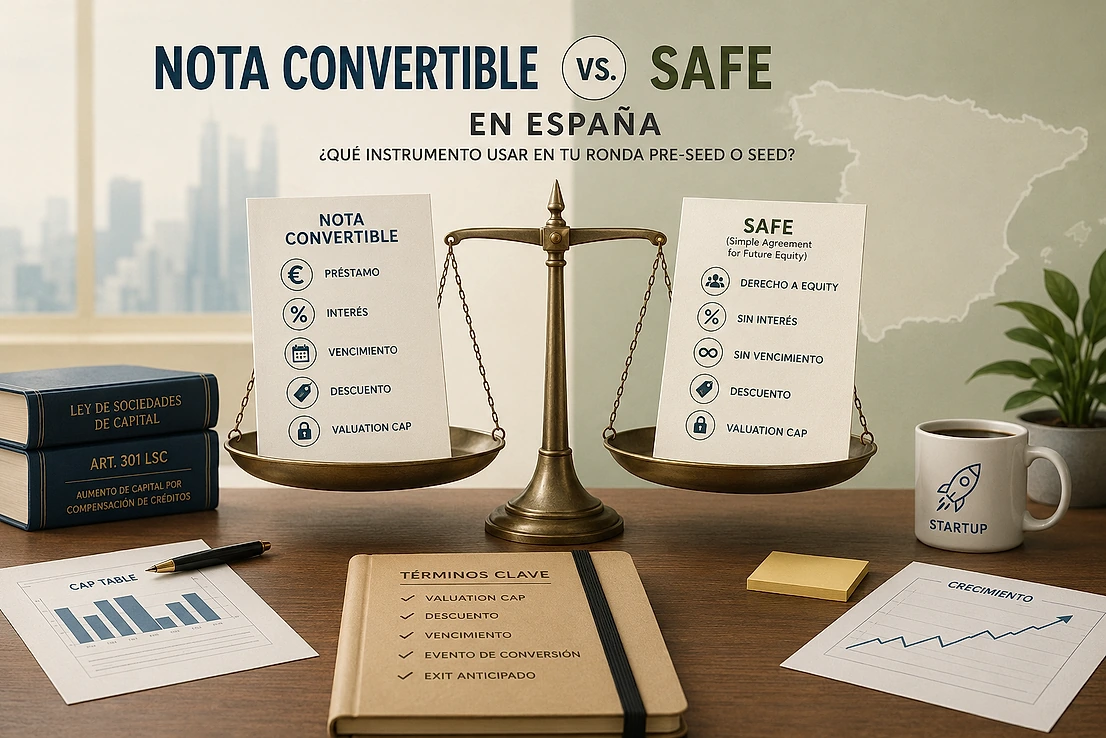
- Investment instrument: Shares, preferred shares, or convertible instruments (SAFE, convertible note).
- Investor rights: Information rights, voting rights, exit rights, anti-dilution, etc.
- Closing conditions: Due diligence, approvals, and other requirements to close the round.
Cap Table Structuring: Visualising Dilution
The cap table (capitalisation table) shows who owns what percentage of the company. It is essential to keep it updated and clear for all rounds.
Practical Cap Table Example
Imagine a startup with two founders (50% each) that raises a Seed round of 300K€ at a pre-money valuation of 1.2M€:
| Shareholder | Before Seed | Investment | After Seed |
|---|---|---|---|
| Founder 1 | 50% | - | 40% |
| Founder 2 | 50% | - | 40% |
| ESOP Pool | 0% | - | 10% |
| Seed Investor | 0% | 300K€ | 20% |
| Total | 100% | 300K€ | 100% |
Critical Clauses in Shareholder Agreements
1. Vesting: Protection Against Premature Departures
Vesting establishes that shares are "earned" over time. Typical example: 4 years of vesting with a 1-year cliff (initial period without rights).
Why it matters: If a co-founder leaves the project at 6 months, they only keep 25% of their shares (if there is a 1-year cliff) or 0% (if they leave before the cliff). The rest returns to the company or is redistributed.
2. Drag-Along and Tag-Along
These clauses regulate the sale of the company:
- Drag-Along: Allows majority shareholders to force minority shareholders to sell their shares in a sale transaction.
- Tag-Along: Allows minority shareholders to participate in a sale when majority shareholders sell.
Example: If an investor with 30% wants to sell to a buyer, the tag-along allows the founders to also sell at the same price and conditions.
3. Anti-dilution: Investor Protection
Protects investors if there is a subsequent round at a lower valuation (down round). There are two main types:
- Full ratchet: Adjusts the conversion price to the lowest price of any subsequent round. Very aggressive for founders.
- Weighted average: Adjusts the price considering the volume and price of the new round. More balanced.
Recommendation: Negotiate weighted average instead of full ratchet whenever possible.
Due Diligence: The Audit Before Investing
Due diligence is the verification process carried out by the investor before closing the round. It includes legal, financial, technical and commercial review. Adequate preparation can accelerate the process and avoid problems.
Due Diligence Preparation Checklist
- Complete corporate documentation (articles of association, minutes, agreements)
- Updated and verified cap table
- Key contracts (clients, suppliers, employees)
- Intellectual property (trademarks, patents, software)
- Financial statements and projections
- Regulatory compliance (GDPR, licences, permits)
- History of previous rounds and terms
Common Mistakes in Investment Rounds
Warning: Mistakes you should avoid:
- Accepting too-high valuations: It can make it impossible to raise future rounds if you do not meet expectations.
- Signing term sheets without understanding the clauses: Once signed, it is difficult to change terms.
- Not reserving ESOP pool before the round: If you reserve it afterwards, you dilute founders more.
- Ignoring liquidity clauses: They can force you to sell when you do not want to.
- Not documenting verbal agreements: Everything must be in writing in the shareholder agreement.
A solid legal structure in investment rounds and well-designed shareholder agreements are the basis for sustainable growth of any startup, reducing future conflicts and facilitating capital entry under optimal conditions.
Need help with your next investment round?
At Satya Legal, we specialize in advising startups in funding processes. We can help you structure your round and negotiate shareholder agreements that protect your interests while attracting the right investors.
Contact usBefore you negotiate, put numbers on what you are giving up: the equity dilution calculator shows your cap table before and after the round.