
How to Register a Trademark in Spain and the EU in 2026: Steps, Cost and the Mistakes That Sink It
There's a phrase that sums up why this matters: in Spain, the trademark belongs to whoever registers it, not whoever used it first. You can spend three years selling under a name — with your website, your social channels, your customers — and discover that someone else registered it first and can now force you to change it, right when it would hurt the most (before a funding round, a launch, or entering another market). Registering your trademark in time is one of the cheapest legal investments with the highest return there is. Let's look at how to do it properly.
National trademark or EU trademark: where to register
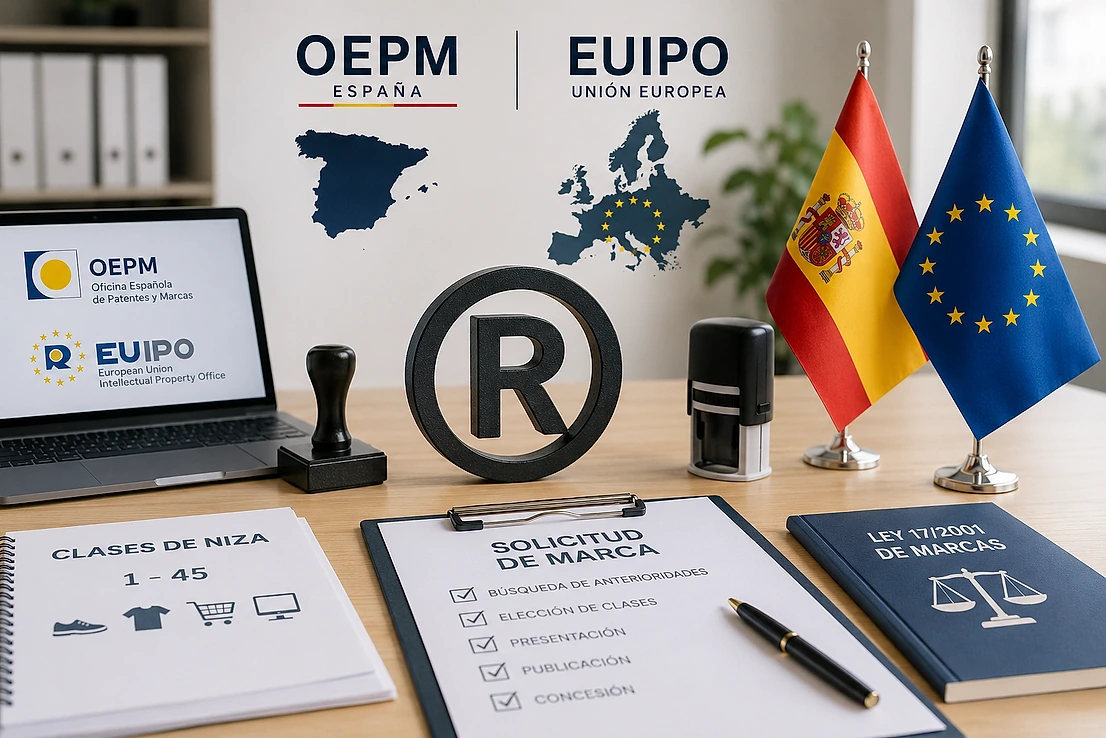
The first decision is territory. If you register with the Spanish Patent and Trademark Office (Oficina Española de Patentes y Marcas, "OEPM"), your trademark is protected only in Spain, under Spain's Trademark Act (Ley 17/2001 de Marcas). If you register an EU trademark with the EUIPO (European Union Intellectual Property Office), you get protection in all 27 member states with a single application, under Regulation (EU) 2017/1001. The practical rule: if you operate, or plan to operate, only in Spain, start with the national trademark; if your project is digital, scalable, or has a European outlook (more so if your name is in English), an EU trademark usually pays off from the start.
Step 1: the prior search (the one almost everyone skips)
Before filing anything, you need to check that an identical or confusingly similar trademark doesn't already exist for similar goods or services. It's the step most people skip, and the one that prevents the most trouble: if you file without searching and there's a similar earlier trademark, its owner can oppose and sink your application — and you'll have lost the fee (which isn't refunded) and the time. The search is done in the OEPM and EUIPO databases, and it's not just about looking for identical names: you need to assess phonetic, visual and conceptual similarities within the relevant classes.
Step 2: choosing the right Nice Classes
Trademarks aren't registered "for everything" — they're registered for specific classes of goods and services under the Nice Classification, which groups economic activity into 45 classes. You choose the classes that cover what you do (and what you'll do in the near term), and your protection is limited to those. Two opposite mistakes happen here: registering too narrowly (covering just one class and leaving out your real activity, so the protection doesn't work) or registering too broadly (paying for classes you don't use). Getting the classes right is half the work of a good registration.
Step 3: filing and the procedure
Once the application is filed (electronically, typically), the office carries out a formal examination and checks the absolute grounds for refusal (that the trademark isn't generic, descriptive or misleading). It's then published in the relevant official bulletin, opening an opposition period (two months under the Spanish procedure) during which owners of earlier trademarks can oppose. If nobody opposes and there are no objections, the trademark is granted. Without oppositions, the procedure is usually resolved within a few months; with an opposition, it takes longer. Once granted, the trademark lasts ten years from the filing date and can be renewed indefinitely for further ten-year periods.
What it really costs
It's worth separating official fees from professional fees. At the OEPM, the application fee is around €125 per class for electronic filing (under the current official fee schedule, which includes the reduction for filing electronically), with an additional cost for each extra class. At the EUIPO, the base fee is €850 for one class, €50 for the second, and €150 for each class from the third onward. On top of that comes the work of searching, classifying and filing. Our fees for handling the national registration or the EU one don't include the official fees — those are paid separately, directly to the OEPM or the EUIPO. (Official fees are published annually, so it's worth confirming the current figure when you file.)
Mistakes that sink your registration
The first is choosing a generic or descriptive trademark ("Zapatos Cómodos" — "Comfortable Shoes" — for footwear): it runs into an absolute ground for refusal and won't be granted. The second is getting the classes wrong and leaving out your real activity. The third is registering the domain and social media handles but not the trademark, believing that's enough (it isn't: they're different things). The fourth is not monitoring the bulletin to oppose when someone tries to register a trademark similar to yours. And the fifth is overlooking that a well-known or reputed third-party trademark can block your registration even in other classes. One more, less obvious: if the founder registers the trademark personally instead of in the company's name, you face the same problem as if you'd never assigned the intellectual property in the code to the company — a key asset sitting off its balance sheet.
What if you want protection in more countries?
If your horizon goes beyond the EU, there's the Madrid System, administered by WIPO (the World Intellectual Property Organization, "OMPI" in Spanish), which lets you apply for protection in multiple countries with a single application based on a base trademark (the national or EU one). It's the natural route for scaling protection as your market grows, without having to register country by country.
Frequently asked questions
How much does it cost to register a trademark?
At the OEPM, the official fee is around €125 per class for electronic filing; at the EUIPO, €850 for one class, plus €50 for the second and €150 for each additional class. On top of that come our filing fees, which don't include those official fees — those are paid separately, directly to the OEPM or the EUIPO.
How long does registration take?
Without oppositions, the national procedure is usually resolved within a few months; if someone opposes during the opposition period (two months after publication), it takes longer. Once granted, the trademark lasts ten years and can be renewed indefinitely.
Should I register my trademark in Spain or across the whole EU?
It depends on where you operate. If it's just Spain, start with the national trademark (OEPM). If your project is European or scalable, an EU trademark (EUIPO) protects all 27 member states with a single application and usually pays off from the start.
Do I need a lawyer to register a trademark?
It's not mandatory, but the prior search and the choice of classes is where a registration is won or lost, and a mistake there costs you a refusal or an opposition. Getting the initial registration right avoids much costlier problems later.
How we see it at Satya Legal
Registering a trademark is one more piece of protecting your intellectual property, and it's not a mere formality: it's a strategic decision about what you protect, where, and against whom. We do the prior search properly, choose the classes with an eye on where you'll be in two years, and get the trademark filed so that when an investor or a competitor shows up, your name is genuinely yours.
Want to register your trademark without surprises?
We run the availability search, choose the right classes, and handle the national or EU registration. We'll tell you whether your trademark is registrable before you pay a single fee.