
50% Personal Income Tax (IRPF) Deduction for Investing in Startups: 2026 Investor's Guide
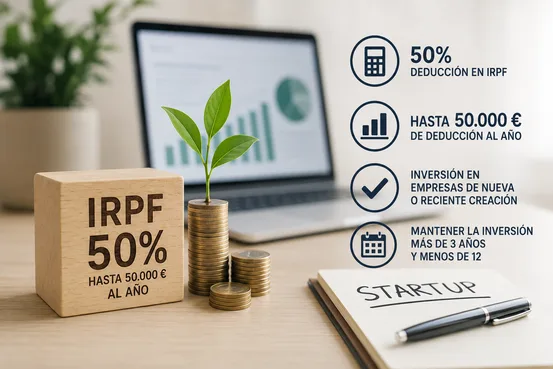
If you're putting money into a startup in 2026, there's one figure worth having clear before you sign anything: you can deduct 50% of your investment from your Personal Income Tax (IRPF), up to a maximum deduction of €50,000 per year. It's one of the most powerful tax incentives available today in Spain for close-proximity investors (the business angel) — and yet it gets lost more often than you'd think, almost always because of a formal oversight that isn't down to the investor but to the company.
Spain's 2025 income tax filing season has just closed, so this is the moment to look ahead: plan this year's investments properly and make sure your portfolio companies will be able to give you the paperwork the Spanish Tax Agency requires. Let's go through it step by step.
How much you can deduct
The deduction is set out in article 68.1 of the Spanish Personal Income Tax Law (Ley 35/2006, "LIRPF"). Since 1 January 2023, with the entry into force of Ley 28/2022 to foster the startup ecosystem (Spain's Startups Law), the rate rose from 30% to 50% and the maximum deduction base went from €60,000 to €100,000 per year. In practice: if you invest €100,000 or more in the year in qualifying companies, your deduction is €50,000; if you invest €40,000, you deduct €20,000, and so on proportionally.
The deduction applies against the state portion of your IRPF tax liability. In some autonomous communities, an additional regional deduction on the same concept may apply to the regional portion of the tax liability (several communities have one, each with its own rate and base). Since these regional deductions vary and change frequently, it's worth checking the one currently in force in your community of residence before relying on it.
Which companies qualify for the deduction
Not just any company will do. Under art. 68.1.2º LIRPF, the entity you invest in must meet three basic conditions:
Be a public limited company, private limited company, worker-owned public limited company or worker-owned private limited company (the Spanish SA, SL, SAL or SLL forms), and not be listed on any organised market (neither a regulated market nor a multilateral trading facility). This condition must be met throughout every year you hold the investment.
Carry out a genuine economic activity, with the personnel and material resources to run it. Companies that are merely holding securities or real estate are excluded.
Have equity not exceeding €400,000 at the start of the tax period in which you acquire the shares (and if the company belongs to a group under art. 42 of the Spanish Commercial Code, the threshold is measured on a group-wide basis).
What you have to meet as an investor
On the investor's side, the conditions under art. 68.1.3º LIRPF are just as important:
You must acquire the shares either when the company is incorporated or in a subsequent capital increase. That capital increase generally has to take place within five years of incorporation. This is where the first advantage of the Startups Law comes in: if the company is a startup ("empresa emergente") within the meaning of art. 3 of Ley 28/2022, that window extends to seven years.
You must hold the shares for more than three years and less than twelve. Selling before three years means losing the deduction.
Your stake, added together with that of your spouse and relatives up to the second degree, cannot exceed 40% of the capital or voting rights on any day of the years you hold the investment. This is where the Startups Law's second major improvement comes in: this 40% cap doesn't apply to the founding partners of a startup (those named in the deed of incorporation). In other words, a founder of a certified startup can claim the deduction for what they invest in their own company — something that was previously off-limits to them.
The startup certification changes the rules
The two advantages above (the seven-year window and the 40% exception for founders) depend on the company holding startup status under Ley 28/2022. Among other requirements, that means being recently created, not having distributed dividends, being headquartered in Spain, having at least 60% of its workforce under contract in Spain, running an innovative and scalable business project, and obtaining ENISA certification under art. 4 of the law (governed by Orden PCM/825/2023). If your deal relies on either of these two advantages, check that the certification exists and is registered with the Commercial Registry (Registro Mercantil). We cover this in detail in our guide to ENISA startup certification.
A useful nuance: the deduction under art. 68.1 doesn't itself require the company to be certified (the base 50% deduction applies to any newly or recently created company that meets the general requirements). Certification is what unlocks the extended deadlines and exceptions. It's worth being clear on this so you don't make a perfectly deductible investment conditional on a formality you may not actually need in your specific case.
The requirement that makes you lose the deduction
This is the point we flag in red, because it's where most deductions fall through. The deduction only applies if the company issues the investor a certificate confirming the requirements are met in the year of the investment (art. 68.1.5º LIRPF), and also files the corresponding informative return with the tax authorities (form 165, "modelo 165"). Without that certificate, the investor cannot apply the deduction, no matter how fully the investment met the substantive conditions.
The practical problem is one of timing and coordination: the investor discovers the requirement in spring, when filing their tax return, by which point the company should already have filed modelo 165 (its deadline is January, covering the previous year). That's why July is a good time for an organised investor: check which portfolio companies need to issue you a certificate for the year's investments and get it agreed in writing, so that modelo 165 goes out smoothly in January and the deduction is available on the next tax return.
Risks worth watching
Beyond certification, there are three points that cause trouble. First, exceeding 40% without being a startup founder: just one day of the year above that threshold is enough to lose the deduction. Second, investing in a company that doesn't actually carry out an economic activity with its own resources (purely asset-holding structures are excluded). Third, forgetting that the deduction has a limit tied to your own situation: the investment eligible for the deduction cannot correspond to a capital gain that has already benefited from the reinvestment exemption under art. 38.2 LIRPF.
One point that works in the investor's favour: Spain's Directorate-General for Taxation (Dirección General de Tributos, DGT) has clarified — in binding ruling (consulta vinculante) V1822-25, of 13 October 2025 — that the deduction doesn't require the company to already be certified as a startup at the time the shares are subscribed. What matters is that the general requirements of art. 68.1 LIRPF are met at the date of payment; if certification is obtained later, it unlocks the extended advantages (the seven-year window for capital increases and the exception to the 40% cap for founding partners) without blocking the deduction for what has already been invested.
Frequently asked questions
How much can I deduct for investing in a startup?
50% of the amount invested, on a maximum base of €100,000 per year — that is, up to €50,000 of annual deduction against the state portion of your IRPF (art. 68.1 LIRPF). Some autonomous communities add their own deduction on the regional portion.
Can a founder claim the deduction for investing in their own startup?
Yes, if the company is a certified startup under Ley 28/2022. For founding partners of startups, the general 40% shareholding cap doesn't apply, so they can claim the deduction for their capital contribution.
How long do I need to hold the investment?
More than three years and less than twelve. If you transfer the shares before three years, you lose the right to the deduction already claimed.
What happens if the startup doesn't give me the certificate?
You won't be able to apply the deduction, even if the investment meets all the substantive requirements. The company's certificate and the filing of modelo 165 are conditions for the deduction, so it's worth agreeing this with the company at the time of investing.
How we see it at Satya Legal
The 50% deduction is an excellent incentive, but it's an incentive with small print: the company's requirements, the holding periods, the 40% cap and, above all, the certification are conditions that need to be secured before investing, not after. As part of our startup advisory work, when we structure a business angel's entry, we lock down from the shareholders' agreement who issues the certificate and when, so the tax advantage doesn't depend on anyone's goodwill come January.
Investing in a startup this year?
We help you structure the investment so the IRPF deduction is secured, reviewing requirements, deadlines and the company's certification. We speak plainly and tell you whether your deal deducts or not before you sign.