

Moving to Spain as an entrepreneur or senior executive: what to decide before you arrive
People who relocate to Spain with a business, a substantial salary or significant wealth tend to arrive with the removal organised and the tax position still unresolved. That is the wrong way round: the most expensive mistakes are made in the first six months (or even before arrival), and almost none of them can be put right afterwards. Your arrival date, how your contract is signed, where your company is run from and what you do with your assets before becoming resident are decisions best taken calmly, and in that order.
1. When you become tax resident
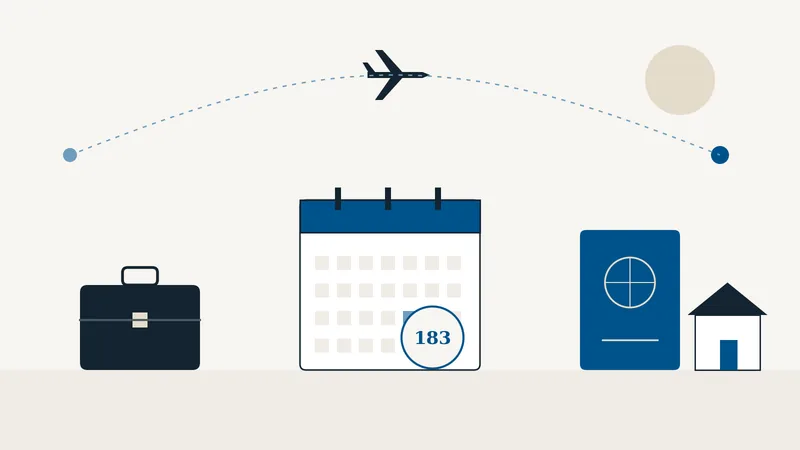
You are tax resident in Spain if you spend more than 183 days here in a calendar year, if the main centre or base of your activities or economic interests is located here, or (unless the contrary is proven) if your spouse, from whom you are not legally separated, and your minor children reside in Spain (art. 9.1 LIRPF, the Spanish Personal Income Tax Act). Residence is determined by full calendar years: Spanish law does not split the year into a resident period and a non-resident period, so arriving in March rather than October can change the tax year in which you start being taxed here on your worldwide income. Where your home country also treats you as resident, the double tax treaty decides, but it is best not to find yourself in that position without having planned for it.
2. The Beckham Law: the decision with a deadline
The special regime for inbound workers (art. 93 LIRPF), known as the Ley Beckham (Beckham Law), allows you to be taxed as a non-resident in the year of your move and the following five years: employment income is taxed at 24% up to 600,000 euros, foreign-source income other than employment income falls outside Spanish personal income tax (IRPF), there is no obligation to file modelo 720 (the return declaring assets held abroad), and Impuesto sobre el Patrimonio (wealth tax) is limited to assets located in Spain. You must not have been resident in Spain in the previous five years, and the move must result from an employment contract (remote work included), an appointment as a company director, or an entrepreneurial activity or qualified professional activity within the meaning of Ley 28/2022. There is also a strict deadline: the election is made on modelo 149 (the election form) within six months of registering with Spanish Social Security.
The factors that determine whether you qualify cannot be fixed once you are here: how, and with whom, you sign your contract, the date on which you start, and whether you are a director of the company employing you. We explain the regime in detail in our guide to the Beckham Law.
3. Your company: make sure it does not move with you by accident
This is the most underestimated risk. A foreign company is treated as resident in Spain if its place of effective management is here, that is, if it is managed and controlled from Spain (art. 8.1 de la Ley del Impuesto sobre Sociedades, the Spanish Corporate Income Tax Act). If the founder or CEO settles in Valencia or Madrid and continues to take every decision for the foreign company from here, the Spanish tax authorities may argue that the entire company is taxable in Spain, not merely the founder's salary. A deliberate choice must be made before arrival: keep genuine management in the home country (with a board that actually functions), set up a Spanish subsidiary for the activity to be carried on here, or migrate the company in an orderly way.
4. Your wealth: what changes the day you become resident
Without the special regime, a resident is taxed in Spain on worldwide income, on worldwide wealth under the Impuesto sobre el Patrimonio (with a general exempt allowance of 700,000 euros and rules that vary considerably from one autonomous community to another) and, where net wealth exceeds three million euros, under the Impuesto Temporal de Solidaridad de las Grandes Fortunas (solidarity tax on large fortunes). Residents must also report their assets abroad on modelo 720 where any one category exceeds 50,000 euros, and any inheritance they receive will be subject in Spain to the Impuesto sobre Sucesiones (inheritance tax) on everything acquired, wherever in the world it is located.
That is why wealth should be put in order before arrival. Some countries tax departing residents on unrealised gains in shareholdings (so-called exit tax), and you need to know what happens when you leave your home country and what acquisition value those assets will carry in Spain. Bear in mind, too, that Spain has its own exit tax for individuals who, having been resident for ten of the last fifteen years, leave holding substantial shareholdings (art. 95 bis LIRPF): planning your arrival and planning a possible future departure are one and the same conversation.
5. Legal residence and housing
European Union citizens need only register with the Registro Central de Extranjeros (Central Register of Foreign Nationals). Everyone else needs an authorisation, and since 3 April 2025 buying property no longer provides one (Ley Orgánica 1/2025 abolished the golden visa). The usual routes for an entrepreneur or executive are the highly qualified professional permit, the entrepreneur permit, the international remote work visa or non-lucrative residence, which does not allow you to work in Spain. As for housing, timing matters: if you buy before becoming resident, you will be taxed as a non-resident for as long as that status lasts, and the structure you buy through (in your own name or via a company) will stay with you for years; we explain this in our guide to investing in Spanish property from abroad.
An indicative timeline. Six to twelve months before: assessment of tax residence and the applicable treaty, the position of your company and the tax consequences of leaving your home country.
Three to six months before: residence route, structuring the employment contract or directorship with the Beckham Law in mind, and decisions on your wealth.
On arrival: empadronamiento (registration at the local town hall), NIE or TIE (foreigner identification number / card) and registration with Social Security. The six months for modelo 149 run from that registration.
First year of residence: keeping track of your days in Spain and, if the special regime does not apply, filing modelo 720 between 1 January and 31 March of the following year.
Frequently asked questions
If I arrive in October, am I tax resident that year?
Under the day-count rule, usually not, because you will not exceed 183 days in that calendar year. However, you are also resident if the centre of your economic interests is in Spain or if your spouse and minor children live here, so all three criteria need to be reviewed.
Can I benefit from the Beckham Law if I work for my own company?
It depends on how the arrangement is structured. Ley 28/2022 extended the regime to company directors, entrepreneurs and highly qualified professionals, with specific requirements for each. This is precisely the kind of decision that must be made before you sign anything.
Do I have to declare my assets abroad?
If you are resident under the general regime, yes: modelo 720 is required where accounts and deposits, securities or real estate abroad exceed 50,000 euros per category. Anyone applying the Beckham Law is not required to file it.
Should I sell my shareholdings before moving?
Not necessarily. It depends on whether your home country taxes departure, on the applicable treaty and on what you intend to do with them in Spain. What you want to avoid is finding out after you have moved.
How we handle it at Satya Legal
We manage the move as a single engagement, in Spanish, English, German, French or Italian, and in coordination with your advisers at home: tax residence and treaty, the Beckham Law, how your company fits in, your residence route, your wealth and, if you are buying a home, the property purchase. We work to a fixed-fee quote and the first consultation is free: tell us about your situation.
Dealing with something similar?
Tell us about it in a 20-minute call. The first consultation is free, no strings attached.
Related Content
Related Articles
Inheriting a property in Spain as a foreigner
Applicable law, documents, the deed without travelling, inheritance tax and a Spanish will.
Read more →
Spain Beckham Law: Special Tax Regime for Inbound Workers
Special regime under art. 93 PITA: flat 24% up to €600,000, Form 149, digital nomads, directors, case studies and compliance checklist.
Read more →
Investing in Spanish property from abroad
Own name or company: non-resident taxes, due diligence and the end of the golden visa.
Read more →