

Convertible Note vs. SAFE in Spain: Which Instrument to Use for Your Pre-Seed or Seed Round
In a pre-seed or seed round almost nobody wants to put a price on the company yet: it's too early, traction is thin, and a bad valuation hurts everyone. To invest quickly without setting a valuation, two instruments are used that people often confuse: the convertible note and the SAFE. The SAFE is the Silicon Valley standard (popularised by Y Combinator); the convertible note is what, in practice, fits well under Spanish law. It's worth understanding why before you sign whichever one lands on your desk.
What a convertible note is
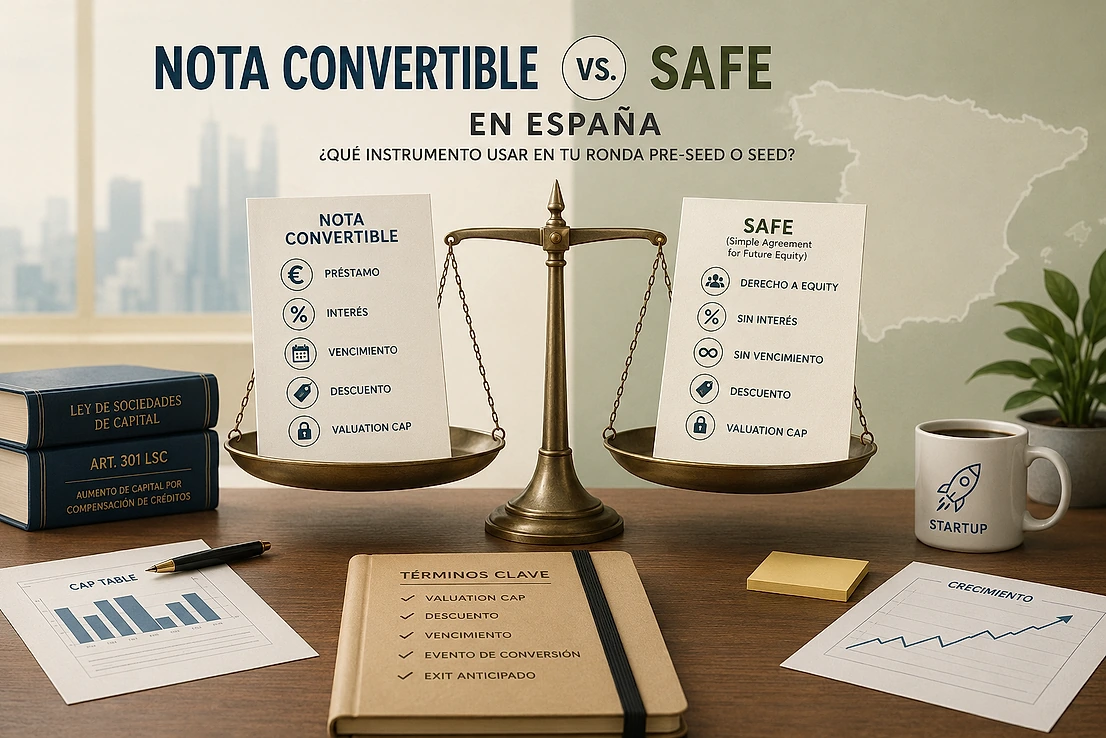
A convertible note is, in essence, a loan that, instead of being repaid in cash, converts into shares at the next funding round. The investor lends an amount today and, when the round arrives (usually a qualified round, meaning one above an agreed minimum amount), that loan converts into equity. Its key pieces are the principal amount, an interest rate that usually accrues until conversion, a maturity date (the deadline by which it should have converted), a discount on the round's price (for example, 20% less than the Series A investors pay) and, very importantly, a valuation cap that sets the maximum valuation at which the investor will convert no matter how high the round closes.
What a SAFE is
The SAFE (Simple Agreement for Future Equity) is a contract created by Y Combinator that is neither debt nor equity: it's a right to receive shares in the future, when the round happens. Unlike a note, a classic SAFE carries no interest and no maturity date, which makes it more comfortable for the founder (there's no date on which a debt to repay suddenly appears). It shares the same economic levers as the note (valuation cap and discount), and since 2018 its standard version has been "post-money" — a technical difference with a big impact on dilution, as we'll see.
Why the SAFE fits poorly under Spanish law
The SAFE is built around US (Delaware) corporate mechanics, where a company can have "authorised" shares that the board issues with great flexibility, and conversion is nearly automatic. In Spain the process is more formal: increasing share capital requires a shareholders' meeting resolution, a public deed before a notary, and registration with the Commercial Registry (Registro Mercantil). There's no equivalent room to issue shares at the board's discretion, so the "automatic" conversion the SAFE assumes has no direct legal channel.
On top of that there's a legal-fit problem. In Spain, conversion of these instruments is usually structured as a capital increase by offsetting claims (aumento de capital por compensación de créditos, under art. 301 of the Ley de Sociedades de Capital — Spain's Capital Companies Act, "LSC"): the investor holds a claim against the company and, instead of collecting it, offsets it by subscribing new shares. That mechanism requires an actual claim to exist. A convertible note is a loan — that is, a claim — so it fits naturally. A SAFE, by definition, is neither debt nor does it create a claim, so it doesn't fit cleanly into that channel and requires adaptation. That's why, in Spanish practice, parties either use a straightforward convertible note or sign an "adapted SAFE" that replicates its logic but is built on a loan structure.
It's worth keeping in mind the requirements of art. 301 LSC, since they set the timetable for conversion: in a private limited company (SL), the claims being offset must be fully liquid and due; in a public limited company (SA), it's enough for at least 25% of them to be, with the rest falling due within no more than five years. In addition, the management body must issue a report on the nature of the claims and the terms of the capital increase.
A third way: the préstamo participativo
In between there's a little-known but useful Spanish instrument: the préstamo participativo (a profit-participating loan under art. 20 of Real Decreto-ley 7/1996). It's a subordinated loan whose interest can be tied to the company's performance and which, for the purposes of capital reduction and grounds for dissolution, counts as equity (patrimonio neto). It's sometimes combined with convertible logic to give the investor a position halfway between debt and equity. It's not the usual choice in a fast seed round, but it's a card worth keeping in mind depending on the deal.
What you're actually negotiating (and it applies to both)
Beyond the wrapper, the economic discussion is the same for the note and the SAFE, and it's where money is won or lost: the valuation cap (the lower it is, the better for the investor and the more it dilutes the founder), the discount, whether there's interest and a maturity date or not, what counts as a conversion event (the round's minimum amount), and what happens if the company is sold before converting (here you agree whether the investor gets their money back, multiplies it, or converts at the cap's valuation). These are clauses that look technical but decide how much of your own company you end up with.
Risks we flag in red
The first is the note's maturity date: if the deadline arrives and there's been no round, the loan falls due and, unless an automatic conversion at a set valuation or an extension has been agreed, the investor could demand repayment at the worst possible moment. Get this settled in writing. The second is the post-money SAFE and stacking: when several SAFEs are signed one after another without tracking the cap table, the dilution piles up on the founders, and the surprise at Series A can be massive. The third is the formalities and taxation of the conversion: the note's interest is taxable, and a capital increase by offsetting claims requires a report from the management body and, depending on the case, other requirements that are worth anticipating. And running through all of it: keep an orderly cap table with every note and every SAFE and its conversion mechanics, because the next round recalculates everything.
Frequently asked questions
Which is better in Spain, a convertible note or a SAFE?
In most cases, the convertible note fits better under Spanish corporate law, because it's a loan (a claim) and its conversion is structured without friction as a capital increase by offsetting claims (art. 301 LSC). The SAFE, since it isn't debt, requires adaptations. An unadapted, "American-style" SAFE can run into legal-fit problems.
What is the valuation cap and why does it matter so much?
It's the maximum valuation at which the investor will convert, no matter how high the next round's valuation is. A low cap favours the investor (they receive more shares) and dilutes the founder more. Together with the discount, it's the figure that gets negotiated the most.
What happens if the note matures and there's been no round?
It depends on what was agreed. If nothing was provided for, the loan falls due and the investor could demand repayment. That's why parties usually agree on an automatic conversion at a predetermined valuation or an extension of the maturity date. Leaving this unresolved is one of the costliest mistakes.
Does the conversion have costs or formalities in Spain?
Yes. The conversion is carried out as a capital increase, with a shareholders' meeting resolution, a public deed, registration with the Commercial Registry, and a report from the management body on the claims. It's worth anticipating timelines and costs, especially if they coincide with closing the round.
How we see it at Satya Legal
The convertible note and the SAFE look simple because they're short documents, and that's the trap: short isn't the same as simple. The conversion mechanics, the maturity date, the cap, and what happens in an early exit decide how the company is really split up two years from now. We prefer to have all of that agreed with an eye on the Series A that's coming, not on the rush to close today's cheque.
Are you about to raise a pre-seed or seed round?
We structure your convertible note or SAFE adapted to Spanish law, negotiate the cap, the discount and the maturity date, and get the conversion ready so your Series A doesn't bring surprises. We'll tell you which instrument suits you before you sign.