

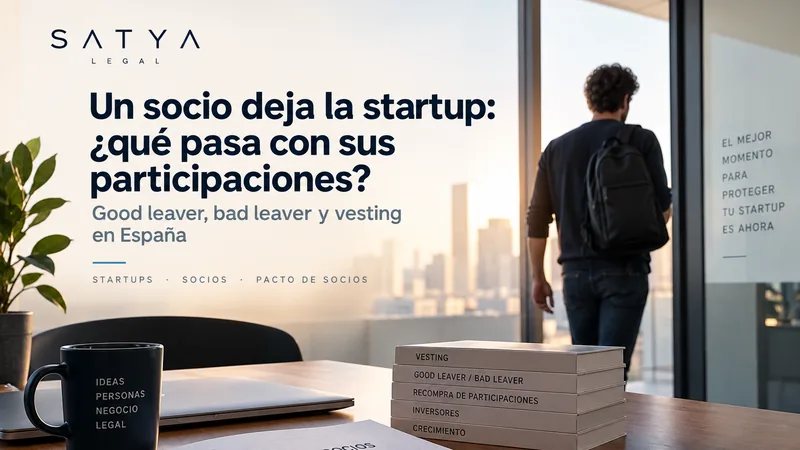
What happens if a co-founder leaves the startup? Vesting, good leaver and bad leaver in Spain
Two people incorporate a Spanish startup at 50/50. Both receive their shares from day one. Six months later, one of them leaves; the other keeps building for years. Does the person who left keep their 50%? The uncomfortable short answer: yes, unless you agreed otherwise. In Spain, being a shareholder of an SL does not depend on working in the company.
In short
- Leaving the job does not mean losing shareholder status. Without an agreement, the departing founder keeps their stake.
- Reverse vesting makes full ownership consolidate with time: a typical schedule runs four years with a twelve-month cliff.
- Good leaver and bad leaver are not legal categories in Spain: they mean whatever your shareholders' agreement says they mean.
- Exit mechanics in an SL must respect the Spanish Companies Act, in particular the share transfer regime and the limits on a company acquiring its own shares (arts. 140-141 LSC).
Shareholder, employee, director: three different things
In an early-stage startup every founder is all three at once, but legally they are independent planes. Shareholder status is ownership: it is only lost by transferring the shares or through the narrow statutory routes. Working for the company and holding the director role are separate relationships that can end without touching ownership. When a founder "leaves", their dedication ends; their shares stay, with voting rights and dividends attached.
Vesting, and why in Spain it is usually reverse vesting
Vesting is a calendar: full ownership is earned with time in the project. Since founders of a Spanish SL receive their shares at incorporation, the usual structure is reverse vesting: you own everything from day one but contractually commit to transfer the unvested part if you leave early. A typical schedule: four years with a twelve-month cliff. A founder with 30% who leaves in month eight has vested nothing; leaving at month twenty-four, half has vested (15%) and the agreed mechanism applies to the other 15%; after four years the 30% is fully theirs.
Good leaver, bad leaver: defined by your agreement, not by law
There is no legal definition of good or bad leaver in Spanish law. A good leaver typically covers departures the partners consider understandable (incapacity, death, an agreed exit, objective circumstances the agreement identifies); a bad leaver covers leaving badly (unjustified abandonment, serious breach, going to compete). The consequences usually differ in price and scope: closer to fair value on vested shares for the good leaver, wider reach or lower price for the bad leaver. None of it operates automatically: what happens is what the agreement provides, if properly built. Price formulas (nominal value, cost, fair value determined by an expert, round-referenced) and the transfer mechanics must be designed within the Spanish Companies Act: share transfers in an SL are restricted by default, and a company acquiring its own shares is only possible in limited statutory cases.
Can a shareholder be forced to sell?
As a general rule, deciding after the fact that someone should leave is not enough. Statutory exclusion exists but only on narrow grounds, and exclusion causes added in the bylaws require unanimous consent. Outside those routes, what remains is whatever was agreed in advance, or negotiation. That is why the tools are built before the conflict: afterwards the margin is narrow and expensive. Investors know this too: a cap table with an inactive founder holding a large stake raises hard questions in due diligence, and many term sheets condition investment on active founders (re)submitting to vesting.
Frequently asked questions
Does a founder who stops working lose their shares?
No. Shareholder status survives leaving the job. Only a previously agreed mechanism (vesting, call option, transfer obligation) or the narrow statutory exclusion routes can change ownership.
Is it too late if we already incorporated without an agreement?
No. A shareholders' agreement can be signed at any time, and most are signed after incorporation. The right moment is while the relationship is good: these clauses negotiate well when nobody knows which side of them they will be on.
If you are incorporating, or there are already several partners and nothing regulates what happens if one leaves, it is far simpler to solve it before the conflict exists. At Satya Legal we help founders design shareholders' agreements with vesting and entry and exit mechanics adapted to each project.
Related Content
Related Articles

Equity, Stock Options and Phantom Shares
Complete guide on equity, stock options and phantom shares for startups
Read more →
Investment rounds and shareholder agreements
Complete guide on investment rounds and the importance of shareholder agreements
Read more →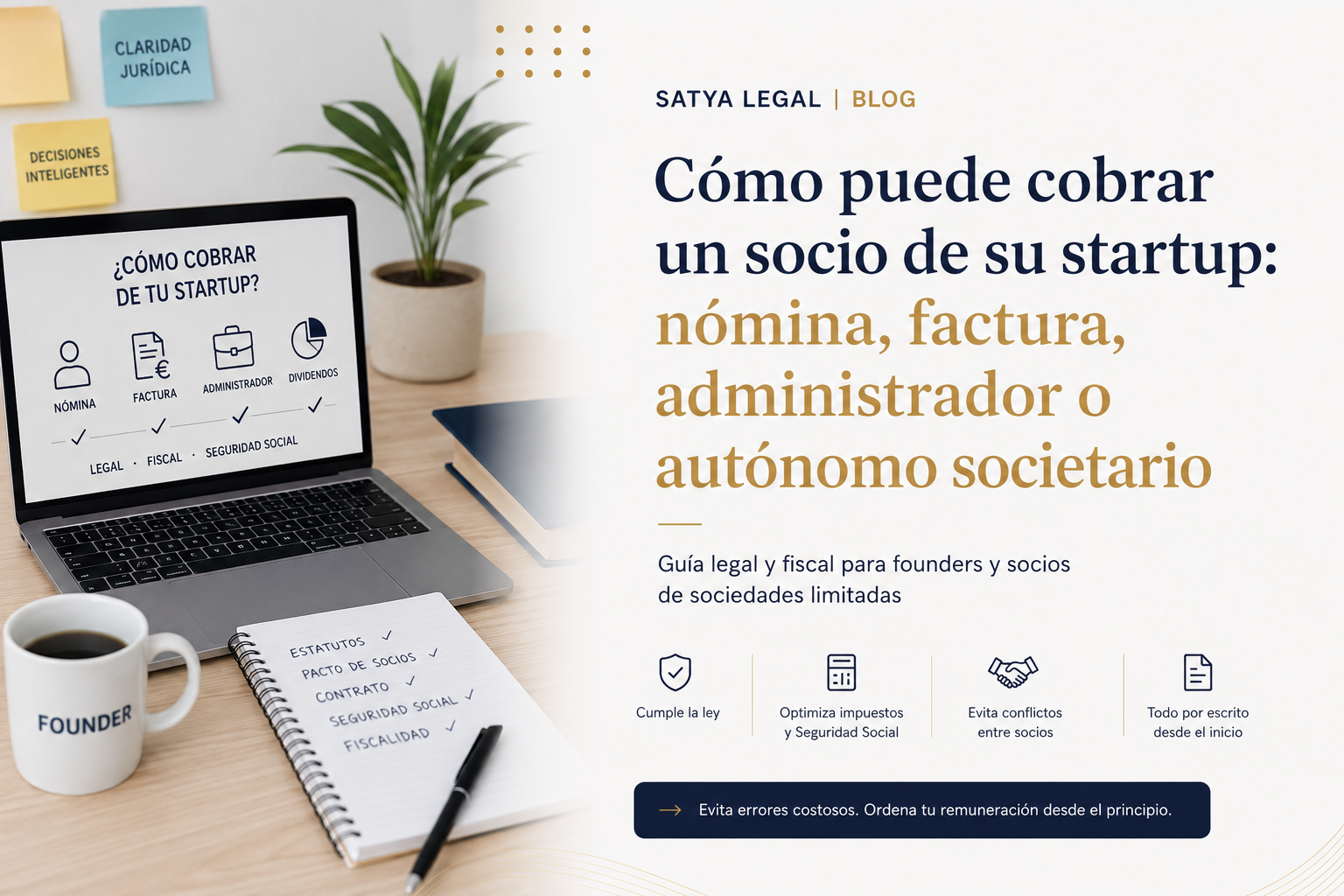
How to Get Paid From Your Startup: Shareholder, Director, Invoice or Payroll
Practical guide for founders on how to get paid from their startup: payroll, invoice, director remuneration or dividends
Read more →