

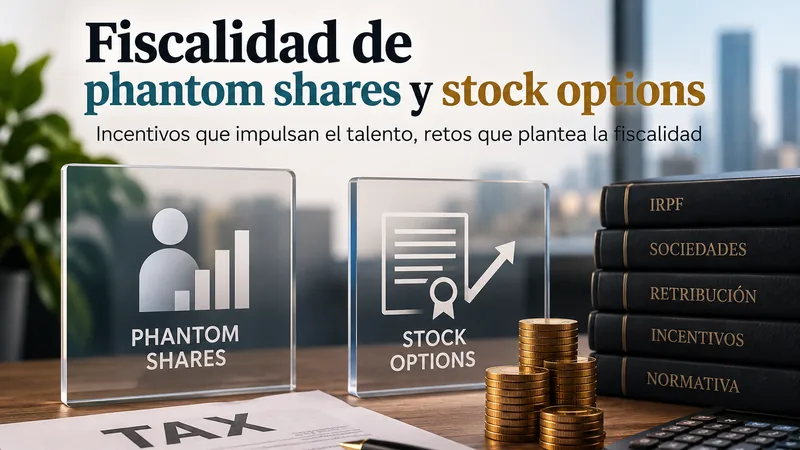
How phantom shares and stock options are taxed in Spain
For startups in Spain, the real difference between phantom shares and stock options is not corporate mechanics but tax: how much the employee pays, and above all when. This guide summarises the rules after Law 28/2022 (the Spanish Startup Law), with the applicable articles.
Both figures produce employment income for Spanish personal income tax purposes (art. 17 of Law 35/2006, "LIRPF"), taxed at the employee's marginal rate on the general base. The differences lie in the exemptions each can use. If you first need the corporate basics, start with our guide to equity, stock options and phantom shares.
Stock options
Granting a personal, non-transferable option is not a taxable event; exercise is. The spread between market value and exercise price is in-kind employment income. Up to 12,000 euros per year can be exempt under art. 42.3.f) LIRPF, subject to the conditions of art. 43 of the IRPF Regulation (same terms for all employees, a 5% ownership cap including close family, three-year holding period).
Certified "emerging companies" under Law 28/2022 get a far better regime: the exemption rises to 50,000 euros per year, the plan only needs to fit the company's general remuneration policy, shares are valued by reference to the last capital increase subscribed by an independent third party in the previous year (art. 43.1.1.g) LIRPF), and, decisively, the non-exempt part is not taxed at exercise. Under art. 14.2.m) LIRPF it is deferred until the company lists, the employee sells, or ten years pass since delivery, whichever comes first. For options, what matters is that the company was certified when the option was granted. On how to obtain certification, see our post on the ENISA emerging-company certification.
Phantom shares
Phantom shares deliver no equity, only a cash claim payable on a trigger event (typically an exit). With no share delivery, neither the 12,000 nor the 50,000 euro exemption applies, nor the deferral rule. The employee is taxed when the amount becomes due (art. 14.1.a) LIRPF) as ordinary salary, subject to withholding. The one mitigant is the 30% reduction of art. 18.2 LIRPF for income generated over more than two years, capped at a 300,000 euro base and subject to non-recurrence conditions; Spanish tax authority (DGT) guidance has repeatedly accepted it for well-designed phantom plans.
The company's side
For corporate income tax, both are deductible personnel costs, but only when the incentive materialises: phantom provisions are deductible when the employee's right becomes due (art. 14 of Law 27/2014), and equity-settled awards when the instruments are delivered (art. 14.6). Both are also subject to social security contributions as salary, up to the maximum contribution base. In practice, a certified startup with a plausible exit is usually better served by stock options; without certification, phantom shares win on simplicity (a contract, no cap table impact) at the price of worse employee taxation. Either way, the plan needs vesting and leaver rules, as we explain in our post on what happens when a co-founder leaves.
Frequently asked questions
Are phantom shares taxed when the plan is signed?
No. The employee is taxed only when the amount becomes due and payable, as employment income. During vesting there is only an expectation, not taxable income.
Does the 50,000 euro exemption apply to any Spanish company?
No. It is reserved for companies certified as emerging companies under Law 28/2022. Other companies can only use the general 12,000 euro exemption, under stricter conditions, and cannot defer taxation of the excess.
When is the company's expense deductible?
Not when the provision is booked, but when the incentive materialises: payment of the phantom bonus, or delivery of the shares (arts. 14 and 14.6 of Law 27/2014).
We design phantom share and stock option plans for startups in Spain and coordinate them with the shareholders' agreement. The first consultation is free.
Dealing with something similar?
Tell us about it in a 20-minute call. The first consultation is free, no strings attached.
Related Content
Related Articles

Equity, Stock Options and Phantom Shares
Complete guide on equity, stock options and phantom shares for startups
Read more →
What happens if a co-founder leaves the startup? Vesting, good leaver and bad leaver in Spain
Why a departing founder keeps their stake without an agreement, how reverse vesting works and what good and bad leaver clauses regulate.
Read more →
ENISA Emerging Company Certification
Complete guide to obtain ENISA emerging company certification
Read more →